
Economy & world events
Interest rates, inflation, jobs, currencies, energy and global events.
Understand what’s changing. See why it matters.
7 days free access · No card required
Follow us on our telegram bot channel for signal updates! (opens Telegram in a new tab)Get short explanations and links to new signals in one message, so you don’t have to keep checking the website.
Start alone does not subscribe you. Send /stop to stop alerts. Some research needs website membership.
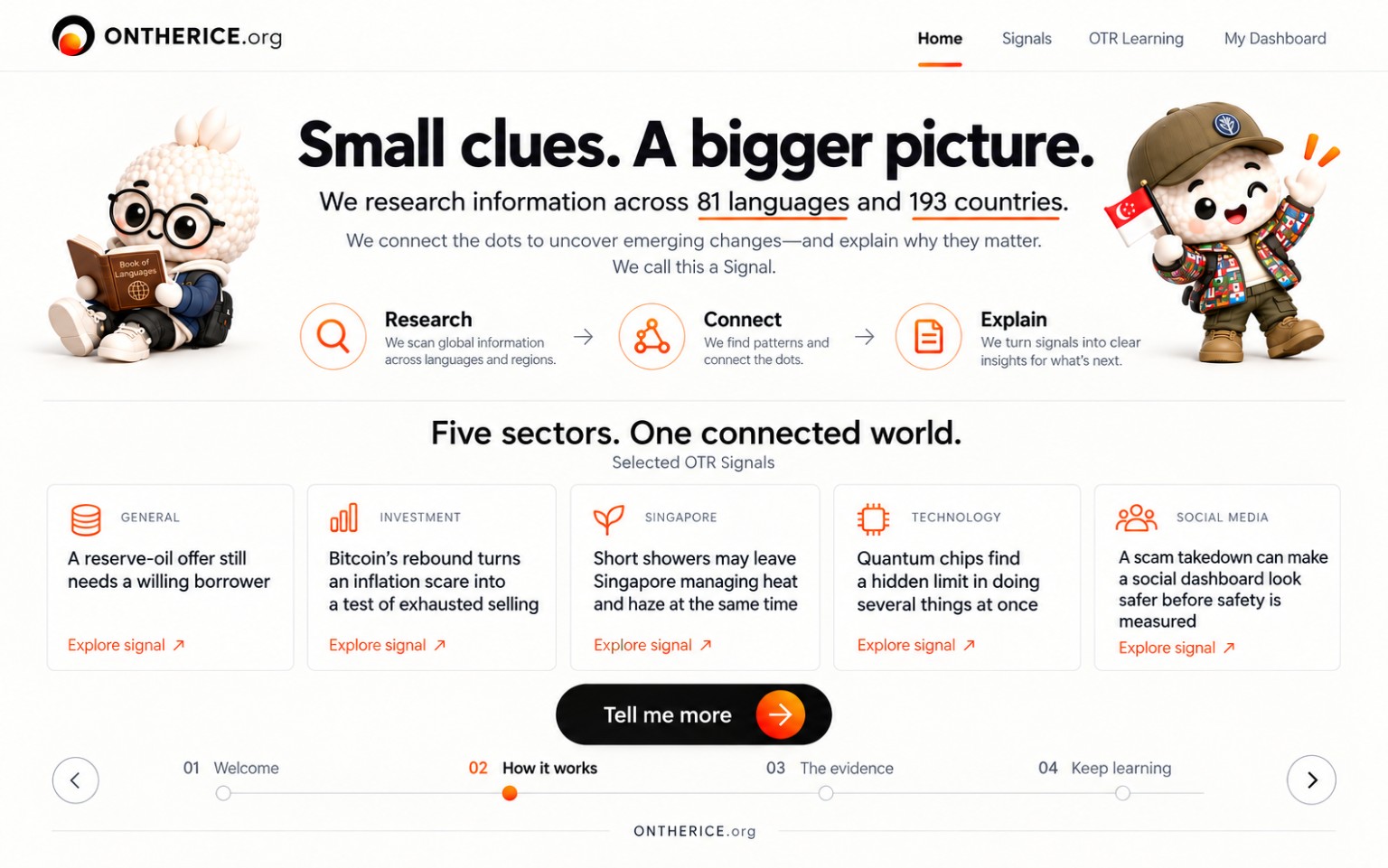
We research public information across languages and regions.
Coverage varies by topic, source access and date. We connect evidence to explain emerging changes as Signals.
We scan global information across languages and regions.
We find patterns and connect the dots.
We turn signals into clear insights for what’s next.
108 areas. Connected in our research database.
Availability and freshness vary by source.
Interest rates, inflation, jobs, currencies, energy and global events.
Company updates, policy changes, AI advances and unexpected events.
Buying and selling pressure, investment flows, supply shortages and demand.
Confidence, fear, expectations, social conversations and crowd behaviour.
Price moves, trading activity, momentum and lessons from past market behaviour.
New models, research findings and practical tests that could change how we work.
Semiconductors, quantum research and the technology behind growing computing needs.
Sales, profits, financing and business results behind the headlines.
Oil, energy security and resource pressures that can affect costs and supply.
Local economic changes, public programmes and developments that affect Singapore.
Funding programmes, AI competitions and opportunities for students and businesses.
Haze, rainfall, wind and environmental changes that can affect daily plans.
Medical tools and scientific findings, with a clear view of what is still being tested.
Digital-asset prices, trading conditions and how different markets move together.
Social-platform changes, content rules and safety issues that shape what people see.
Rate decisions, central-bank guidance and what they may mean for borrowing costs.
Prices of everyday goods, energy costs and the gap between forecasts and actual inflation.
Employment, pay and labour-market changes that shape household spending and business costs.
Economic output, productivity and the evidence behind growth forecasts.
Government spending, debt repayments and pressures on public finances.
Currency moves, central-bank intervention and how exchange rates affect trade and prices.
Borrowing rates, debt maturity dates and signs that lenders see greater risk.
Bank lending, deposits, bad loans and stress that could spread through the financial system.
Trade barriers, sanctions and technology-transfer rules, from proposals to effective policy.
Conflict, negotiations and possible effects on people, energy and trade routes.
Political transitions, campaign expectations and policy changes that may follow.
Public unrest and labour action, including effects on transport, services and businesses.
Deal terms, financing and approvals, keeping proposed deals separate from completed ones.
How companies raise money, manage debt and fund expansion.
New shares and repurchases, separating announced plans from completed transactions.
Company results against earlier expectations, with the strongest reasons for doubt.
Customer orders, delivery schedules and whether promised demand turns into revenue.
Retail sales, changing shopping habits and signs of pressure on household budgets.
Vessel arrivals, freight delays, port activity and bottlenecks in moving goods.
Air cargo, passenger demand and disruptions that can affect travel businesses.
Fuel and raw-material stocks, supply surprises and shortages.
Electricity demand, grid connections and when planned capacity becomes usable.
Solar manufacturing, low-carbon power and the policy behind new energy projects.
Where available, insurance prices and coverage changes around disrupted trade routes.
Where available, buy and sell orders, market depth and the gap between quoted prices.
Where available, completed trades and buying or selling pressure, separate from planned flows.
Where available, money entering and leaving funds, rather than assuming flows from price moves.
Where available, borrowed shares, short positions and pressure to buy them back.
Where available, options pricing and positioning around uncertainty and expiry dates.
Futures contracts, funding costs and differences between spot and future prices.
Borrowed exposure and forced position closures, using source-specific data where available.
Fees, spreads, borrowing costs and how they change the value of a trading idea.
How many assets rise or fall together, rather than judging a market by one headline asset.
Research into whether investors move together, while testing other explanations.
Research into loss aversion, regret and the tendency to hold losing positions.
Research into excitement, panic and speculative behaviour without guessing individual motives.
What people expect before events, and how those expectations differ from later evidence.
Where evidence allows, differences between individual investors and large institutions.
Discussion timing, engagement and source origins, without treating repeated posts as fresh proof.
How long price moves persist, when they speed up and when they lose strength.
Changes in price direction and whether apparent recoveries continue or fade.
Moves beyond recent price ranges, including retests and breakouts that fail.
Repeated chart shapes and candlestick patterns, tested rather than assumed to work.
Changing price swings, sharp jumps and periods when risk becomes unusually high.
How far markets fall, how long losses last and how recoveries differ.
Trading sessions, holidays, month-end effects and other recurring timing patterns.
How stocks, bonds, currencies, commodities and crypto move together or pull apart.
Price moves before and after events, including delayed reactions and competing explanations.
Past outcomes, simple comparison models and failed tests that challenge a new idea.
Source quality, missing data and the difference between event, price and publication times.
Where available, on-chain transfers and exchange flows, with their limits kept clear.
Stablecoin supply changes and cases where tokens move away from their target value.
New token supply, release schedules and changes that can affect available coins.
Blockchain activity, transaction fees and whether network use supports its business story.
Validator activity, staking income and the risks behind promised network rewards.
Digital-asset loans, collateral concentration and how stress can spread between protocols.
How people and businesses use AI, and where measured results differ from expectations.
Multi-step software, workplace automation and the permissions needed to complete real tasks.
Model benchmarks, practical performance and evidence that checks a developer’s claims.
Licensing, publisher rights and the rules governing which information AI systems may use.
Computing demand, equipment values, financing and the cost of running data centres.
Chip-making tools, memory, packaging and production limits across the computing supply chain.
Sensors, movement planning and tests of machines working in physical environments.
Quantum hardware, error reduction and software, with lab results kept separate from deployment.
Security incidents and technology failures that can disrupt services or markets.
Planetary science, asteroid-risk studies and the limits of simulations and lab findings.
New material properties and early experiments that may support future technology.
Brain activity, sensory systems and early research whose real-world use still needs testing.
Diagnostic devices and medical experiments, including sample sizes and validation limits.
Whether research methods, measurements and claimed discoveries can be checked and repeated.
Pollution readings, regional differences and why short and long measurement windows matter.
Local weather measurements and how changing conditions can affect daily decisions.
Fire reports, hotspots and wind patterns that can move smoke across borders.
Water extremes and their possible effects on communities, production and supply.
Official event records and impact reports, without treating a rising count as proof of a trend.
Outbreak alerts, health guidance and the evidence behind changing public-health risks.
Crowd movement, emergency access and verified incident reports.
Training, automation and how technology changes the tasks people do.
Digital adoption, operating costs and practical support for smaller businesses.
Collaborations between companies, universities and public agencies, from plans to results.
Learning challenges, entry requirements and opportunities for young builders.
Application dates, support limits and the difference between open and closed programmes.
Where available, official project awards, named suppliers and approved spending.
How platforms change discovery, search and the controls people have over their feeds.
Distribution, viewer incentives and whether attention leads to lasting audience growth.
Platform bans, content policies and the evidence behind enforcement decisions.
Synthetic music, video and text, including labelling rules and mistakes in detection.
Age checks, proposed safeguards and rules affecting young people on social platforms.
Music, virtual performances and changing audience habits, with commercial effects checked separately.
Competition rules and regulatory reviews that can change how businesses operate.
Scams, exposed information and failures of trust that can affect people and businesses.
Housing-price evidence, property funds and their links to borrowing costs.
Agricultural prices, weather exposure and supply pressures affecting essential food crops.
Follow the evidence. Make up your own mind.
A curious mind sees more.
Understand how we research information, connect evidence and build a Signal—in plain English.
Research · Evidence · Connections
Explore OTR LearningWelcome · 1 of 4
Original OTR research from five sectors.