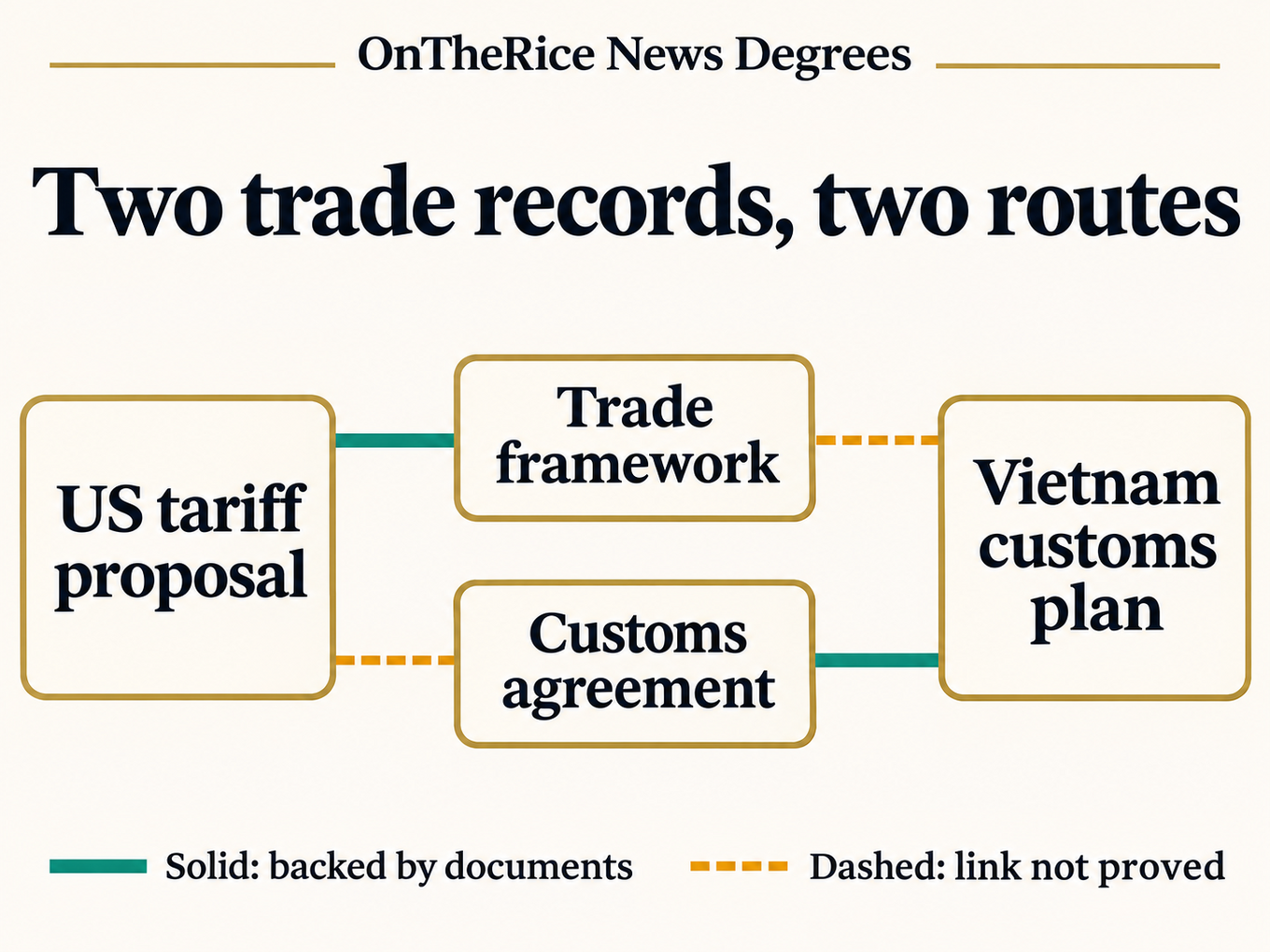
The same tariff headline can mean two different bills
Before accepting a surcharge, check the product code, where it was made and which rule applies today.
ONTHERICE / A READER’S GUIDE
News Degrees shows how two stories might be linked, and what the evidence can actually prove.
Why it matters: Find out what to trust and what to check before you act.
Made-up example: A shop moves your delivery date. A canal has cut the number of ships it lets through. Are the two stories connected? Follow the news in between to see what’s known, what’s still a guess and what to check next.
THE ARCHIVE
Pick an edition and start with one question: “What do the sources actually show?”
Open an edition to read the full story, see its visuals and check its sources.
Before accepting a surcharge, check the product code, where it was made and which rule applies today.
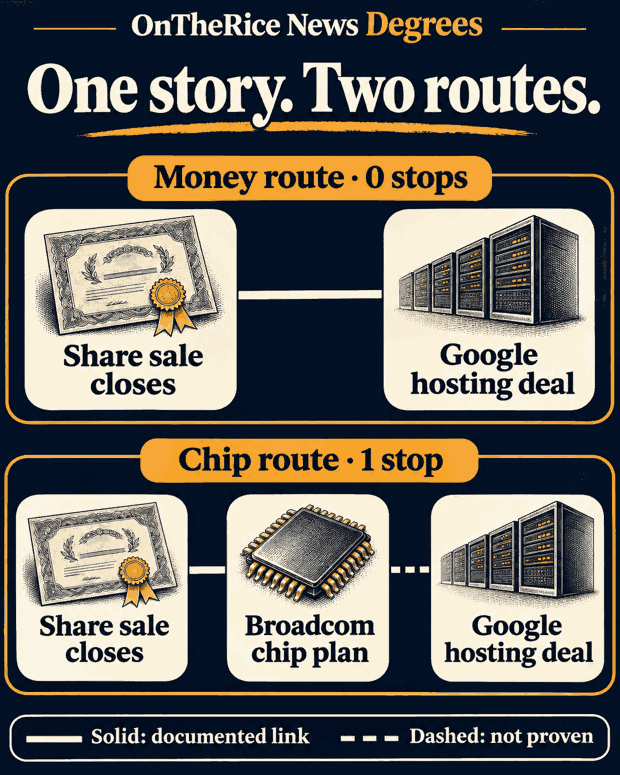
Google’s share purchase halved how much Anthropic could still ask for. A separate hosting bill stayed in place.
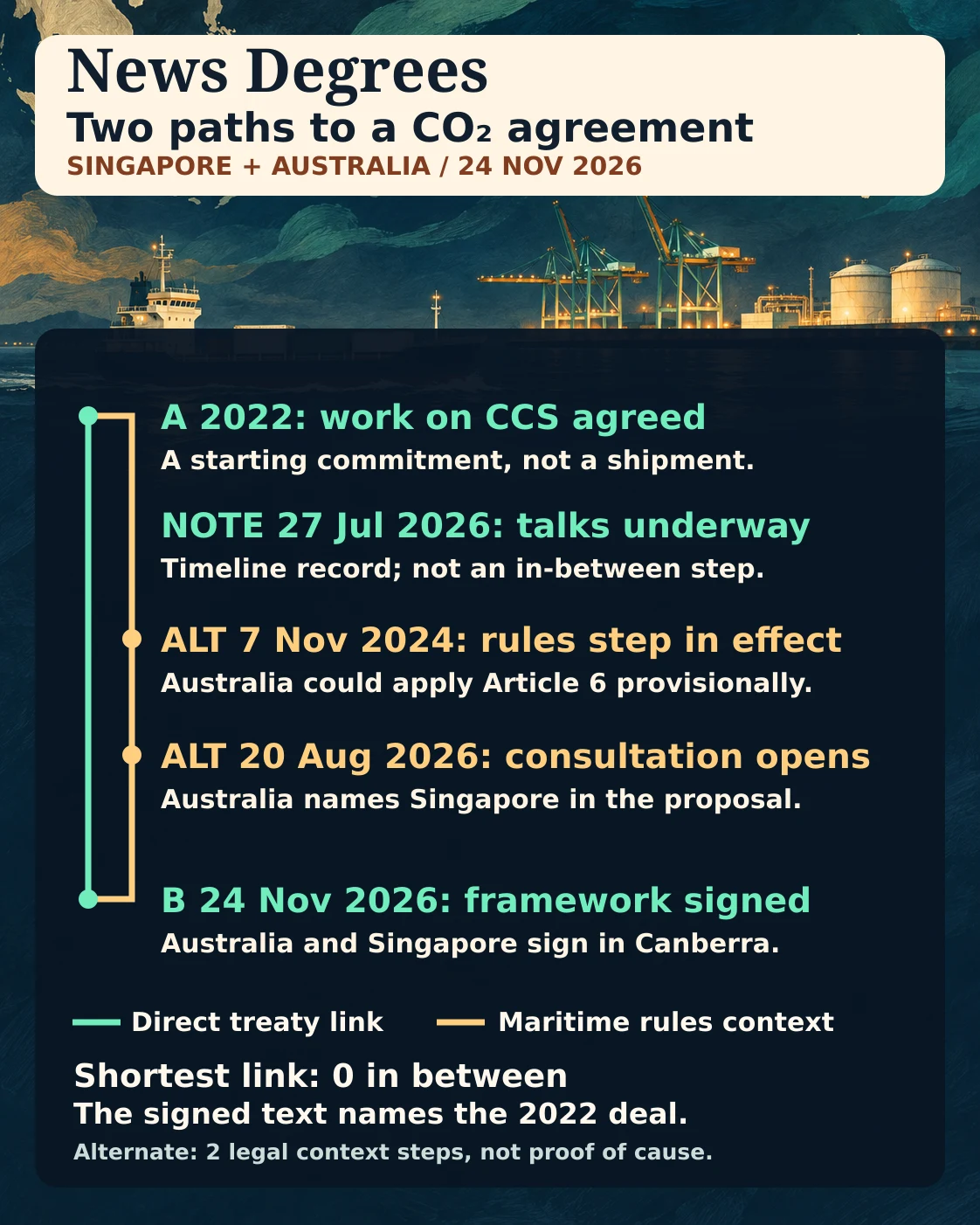
See how four years of talks and rule changes led to the signing, and what to check before calling it a working route.
01 / WHAT IT DOES
We start with two dated stories and show one or more ways they might connect. Each stop is another story. Each line gives you a link to check against dated sources. Stories can share a topic or happen in the same week without one leading to the other.
02 / WHY IT MATTERS
Say you run that shop. You can warn customers about the new date without blaming the canal. Knowing where the evidence stops helps you decide what to say, what to do and which question to ask next.
A Signal tells you what we found. In News Degrees, you can follow the evidence and test your own idea. Start with your best explanation, then name one record that could prove you wrong.
03 / HOW TO READ IT
Read the first and last stories. Check their dates and open their original sources.
Degrees: how many stories sit between them.
Strength: how well the evidence backs each link.
A longer route isn’t stronger proof. Start with the shortest route the sources support. If a different route also fits, check what would tell them apart.
04 / WORKED EXAMPLE · MADE UP
This is a practice story, not a dated edition. Follow the path from A to B.
The carrier’s notice says this limit delayed its ship. That backs this link, not the whole route.
We don’t know if the shop’s stock was on that ship. The supplier may have sent the order late instead. Both routes could fit the same last story.
Check the shipment record. If it names the delayed ship, that supports the story. If the stock travelled by air, the ship wasn’t the reason. Either way, the shop can tell customers their new date now.
How could a drought in Panama change where U.S. cargo arrives?
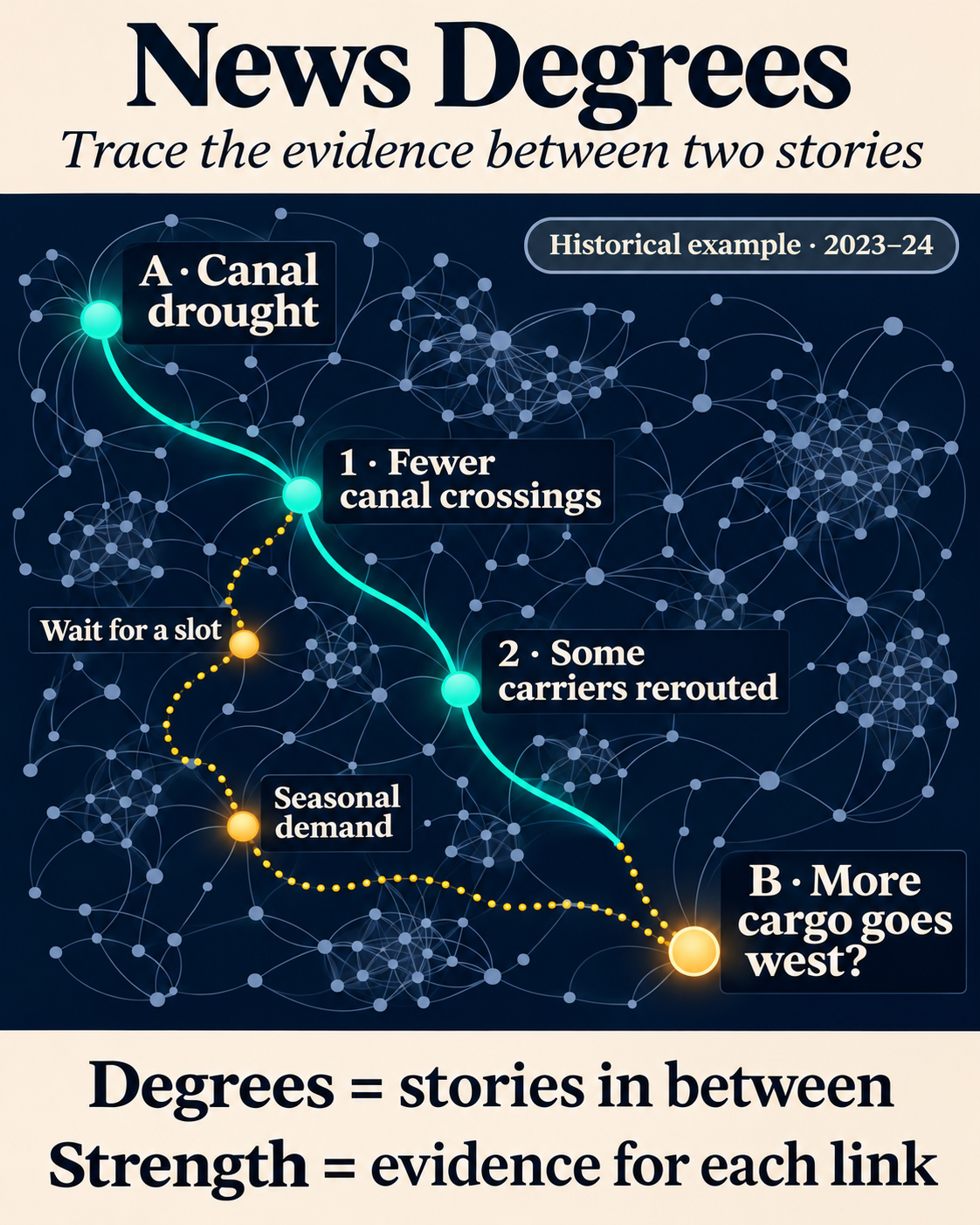
Historical example, 2023–24. A: canal drought. Story 1: fewer canal crossings. Story 2: some carriers rerouted. B asks if more cargo went west; the image does not claim that it did. The amber branches mark waiting for a slot and seasonal demand as other possibilities to examine. Two stories sit between A and B, but counting them does not prove one caused the other. Strength depends on the evidence behind each link. The background illustrates how a network could span thousands of reports, not an index of thousands of live sources.
01 / SOURCES & FINDINGS
The canal operator planned fewer daily crossings to save water. These were planned limits, not a count of ships that actually crossed.
After more rain and steps to save water, the canal changed its plan. From 16 January, it would allow 24 crossings a day. The earlier plan was not the final one.
Some ships took different routes; some carriers sent containers across Panama by rail before reloading them. A change of route does not require a change of U.S. port.
Compare imports by port, country of origin and product. The totals show each coast’s share of U.S. imports, but not which way a ship sailed.
02 / ONTHERICE ANALYSIS
A canal restriction changes the options for a shipping line. It does not by itself tell us where cargo arrived. A ship can take a longer route and still unload at the same port.
Look for notices showing a shipping line moved the same service from East or Gulf Coast ports to West Coast ports. For the same product and country of origin, did the West Coast take a larger share of U.S. imports that arrive by ship after that switch? Compare the same calendar months across years so normal shopping seasons do not hide the change.
The drought is a weaker explanation if the West Coast’s share stayed flat or rose before the restrictions. It is weaker, too, if routes that did not use Panama saw the same change. Check other disruptions, including changes to Red Sea services, before saying the canal caused the shift.
03 / RESEARCH WORKSPACE
Walk through one simplified path or build a private deck of questions. These are example cards, not a live search of articles.
Illustrative exampleLimits on ship depth and bookings can reduce the number of crossings available to cargo ships.
Fewer available crossings can make another route more attractive to carriers.
If ships stop at different ports, some goods may enter the U.S. in a different place.
Ships that cannot book one of the remaining crossings may have to wait.
More time at sea or at anchor can raise the cost of a trip.
Shippers may switch routes if the savings cover the extra cost of moving goods inland.
If shippers keep booking a new route, some goods may start arriving at another port.
Limits on ship depth and bookings can reduce the number of crossings available to cargo ships.
Fewer available crossings can make another route more attractive to carriers.
Ships that cannot book one of the remaining crossings may have to wait.
More time at sea or at anchor can raise the cost of a trip.
Shippers may switch routes if the savings cover the extra cost of moving goods inland.
Save and arrange cards to explore a hypothesis: an idea you can test. This deck stays in this browser and does not sync to your account. If storage is unavailable, changes last only until you close or reload the page.
Limits on ship depth and bookings can reduce the number of crossings available to cargo ships.
Check the dates on Panama Canal notices against the number of crossings offered.
Fewer available crossings can make another route more attractive to carriers.
Compare the canal’s booking notices with the shipping lines’ route updates.
If ships stop at different ports, some goods may enter the U.S. in a different place.
Compare revised service maps with import volumes by port.
Ships that cannot book one of the remaining crossings may have to wait.
Compare the number of slots offered with how long ships waited.
More time at sea or at anchor can raise the cost of a trip.
Compare waiting times with long-term shipping prices and prices for trips booked that day.
Shippers may switch routes if the savings cover the extra cost of moving goods inland.
Compare how often each route was booked, how much it cost and how long delivery took.
If shippers keep booking a new route, some goods may start arriving at another port.
Compare shipping schedules with customs records for each port.
Low water can limit how many ships are allowed to pass.
Compare reservoir readings with canal restrictions on the same dates.
Higher prices can make other routes more attractive, but rates alone do not prove rerouting.
Compare prices for trips booked that day with changes in routes and the amount shipped.
24 November 2026: Singapore’s economy grew 6.1%. Why were September café takings nearly flat?